
Posted on 11 February 2017 - 12:26 PM
BlueMinionHD wrote
So, is it to your best advantage to stick with your original choice or switch your choice?
AND WHY?!
https://en.wikipedia.org/wiki/Monty_Hall_problem
haha
Last edited on 11 February 2017 - 12:51 PM by AbdelTheIguana
Meh, It was worth a tryPosted on 11 February 2017 - 03:07 PM
What does E =?Put it in an essay of what E ='s
Posted on 11 February 2017 - 03:28 PM
BlueMinionHD wrote
Put it in an essay of what E ='s
E = sqrt(p^2 + m^2) in natural units (c=1).
E = letter in Latin alphabet
E = (1/2)mv^2
E = mc^2 (this the first equation for a non-moving object)
etc.
Posted on 13 February 2017 - 12:29 AM
how would you simplify these rational expressions(x/x+1 +1) x 1+x/2x-1
a^2-9/2a^2+1 x (6a+1/a-3 + 6a-1/a+3)
1-2x/2x+1 + x^2+3x/4x^2-1 ÷ 3+x/4x+2
these problems have a lot of steps and i'm getting tripped up somewhere
Posted on 13 February 2017 - 03:30 AM
SporkHandles wrote
(x/x+1 +1) x 1+x/2x-1
a^2-9/2a^2+1 x (6a+1/a-3 + 6a-1/a+3)
1-2x/2x+1 + x^2+3x/4x^2-1 ÷ 3+x/4x+2
these problems have a lot of steps and i'm getting tripped up somewhere
I will do my best to figure out what you mean by your notation. I'll use more parentheses to be as clear as possible by what I mean.
1.) x/(x+1) + 1 = x/(x+1) + (x+1)/(x+1) = (x+x+1)/(x+1) = (2x+1)/(x+1)
Assuming that x in the middle is a multiplication sign, we have
[(2x+1)(1+x)]/[(x+1)(2x-1)] = (2x+1)/(2x-1), by cancelling the (x+1) term.
2.) (a^2-9)/(2a^2+1) = [(a+3)(a-3)]/(2a^2+1)
(6a+1)/(a-3) + (6a-1)/(a+3) = [(6a+1)(a+3)+(6a-1)(a-3)]/[(a+3)(a-3)] = (6a^2 + 19a + 3 + 6a^2 - 19a + 3)/[(a+3)(a-3)]
= (12a^2 + 6)/[(a+3)(a-3)] = [6(2a^2 +1)]/[(a+3)(a-3)]
Multiplying the two terms, we have only 6 left over after cancelling out terms.
3.) 1-2x/2x+1 + x^2+3x/4x^2-1 ÷ 3+x/4x+2
(x^2+3x)/(4x^2-1) = [x(x+3)]/[(2x+1)(2x-1)]
(3+x)/(4x+2) = (x+3)/[2(2x+1)]
Recall that division is just multiplication by the reciprocal, cancelling out the (x+3) and (2x+1) terms, leaving
(2x)/(2x-1).
Now we can add in the other term:
[(1-2x)(2x-1)+(2x)(2x+1)]/[(2x+1)(2x-1)] = (-4x^2 + 4x - 1 + 4x^2 + 2x)/[(2x+1)(2x-1)] = (6x - 1)/[(2x+1)(2x-1)].
I feel like that last expression should reduce on the numerator to (2x-1) allowing those terms to cancel, but that have been done on purpose.
Double check my work for me, since I'm doing this at 3:30 AM.
Last edited on 17 February 2017 - 06:51 PM by whittams
AlbertEinstein wrote
SporkHandles wrote...
I will do my best to figure out what you mean by your notation. I'll use more parentheses to be as clear as possible by what I mean.
1.) x/(x+1) + 1 = x/(x+1) + (x+1)/(x+1) = (x+x+1)/(x+1) = (2x+1)/(x+1)
Assuming that x in the middle is a multiplication sign, we have
[(2x+1)(1+x)]/[(x+1)(2x-1)] = (2x+1)/(2x-1), by cancelling the (x+1) term.
2.) (a^2-9)/(2a^2+1) = [(a+3)(a-3)]/(2a^2+1)
(6a+1)/(a-3) + (6a-1)/(a+3) = [(6a+1)(a+3)+(6a-1)(a-3)]/[(a+3)(a-3)] = (6a^2 + 19a + 3 + 6a^2 - 19a + 3)/[(a+3)(a-3)]
= (12a^2 + 6)/[(a+3)(a-3)] = [6(2a^2 +1)]/[(a+3)(a-3)]
Multiplying the two terms, we have only 6 left over after cancelling out terms.
3.) 1-2x/2x+1 + x^2+3x/4x^2-1 ÷ 3+x/4x+2
(x^2+3x)/(4x^2-1) = [x(x+3)]/[(2x+1)(2x-1)]
(3+x)/(4x+2) = (x+3)/[2(2x+1)]
Recall that division is just multiplication by the reciprocal, cancelling out the (x+3) and (2x+1) terms, leaving
(2x)/(2x-1).
Now we can add in the other term:
[(1-2x)(2x-1)+(2x)(2x+1)]/[(2x+1)(2x-1)] = (-4x^2 + 4x - 1 + 4x^2 + 2x)/[(2x+1)(2x-1)] = (6x - 1)/[(2x+1)(2x-1)].
I feel like that last expression should reduce on the numerator to (2x-1) allowing those terms to cancel, but that have been done on purpose.
Double check my work for me, since I'm doing this at 3:30 AM.
everything except the second problem seems to be wrong, I'll look through it again and see if I can find anything but besides that nothing else.
I dont't know if it helps to figure it out but its kinda of similar to this problem
(5x+y/x-5y + 5x-y/x+5y) divided by x^2+y^2/x^2-25y^2
Posted on 18 February 2017 - 12:57 AM
SporkHandles wrote
AlbertEinstein wrote...
everything except the second problem seems to be wrong, I'll look through it again and see if I can find anything but besides that nothing else.
I dont't know if it helps to figure it out but its kinda of similar to this problem
(5x+y/x-5y + 5x-y/x+5y) divided by x^2+y^2/x^2-25y^2
Another possible problem is that I'm not interpreting what you're typing correctly.
Use parentheses to denote numerators and denominators.
Posted on 20 February 2017 - 05:13 AM
SporkHandles wrote
AlbertEinstein wrote...
everything except the second problem seems to be wrong, I'll look through it again and see if I can find anything but besides that nothing else.
I dont't know if it helps to figure it out but its kinda of similar to this problem
(5x+y/x-5y + 5x-y/x+5y) divided by x^2+y^2/x^2-25y^2
I've double checked each of my answers, and I stand by each of them.
The two possibilities are
a.) I've misinterpreted what you've written in the problem, or
b.) I've completely forgotten how to manipulate rational expressions and polynomials.
I sure hope it's the former. Also, your other problem simplifies to 10.
Last edited on 21 February 2017 - 06:23 PM by *deleted-277605
Automatically DeletedPosted on 21 February 2017 - 05:51 PM
2+2Get it wrong and I lose respek 4 u
Last edited on 21 February 2017 - 07:41 PM by AlbertEinstein
skyboy2013 wrote
still in middle school dont blame me
Let's start with the first digit. How many choices do we have to choose from for this one?
We have ten possibilities (0,1,2,…,9). So far so good.
Now what about the next one? We again have ten possibilities to choose from.
But how many choices do we have all together now? Suppose we chose 1 as our first digit. Then with the second digit we have ten choices. Same goes for if we chose 2 or 7. So the number of choices we get altogether just for the first two digits is 10+10+10+…+10 ten times, or 10*10.
For the third digit, we can follow the same reasoning for the 100 choices we already have to get 10*10*10.
If we keep following this reasoning up to the ninth digit, we get 10^9 as the number of possible choices of these strings of digits.
The probability of finding ONE of these is just 1/10^9, or 10^(-9), which is a very, very, VERY small chance.
Posted on 21 February 2017 - 07:39 PM
Intimidated wrote
Get it wrong and I lose respek 4 u
I will get back to you on this one. I need to get some help.
Posted on 22 February 2017 - 02:59 PM
Albert if u are who u really say u are. Explain E=mc squaredPosted on 22 February 2017 - 04:45 PM
Cleqn wrote
This equation gives the relationship between mass and energy. Mass inherently has some amount energy associated with it.
This is a result of Einstein's special theory of relativity. Energy, just like velocities and momenta, is relative. A person moving doesn't see him or herself moving, but observers do.
So if one person sees me moving, I have some kinetic energy according to them. However, in my frame of reference, I don't see myself moving and I have no kinetic energy. Meanwhile, yet another observer could be moving half my speed and see me moving at some velocity different from the other observer, giving me a different kinetic energy in their frame.
The question comes up naturally: which one of these is my actual energy?
Special relativity gives a solution to this. Special relativity is essentially the theory of things moving at very fast speeds (by fast, I mean nearing the speed of light–the speed limit of the universe) and how observers perceive these speeds. Weird stuff begins to happen when you start moving at high speeds. Time starts to slow down, lengths start to warp and contract, and a bunch of other oddities occur.
Applying special relativistic methods to the problem of transforming energy from one reference frame to another gives a relativistic invariant (something that is constant no matter what reference frame you're in): E^2 - p^2c^2 = m^2c^4. Mass is a relativistic invariant as well (depending on the formalism you use). So given a particle of mass m and momentum p, we can get the energy E = sqrt(p^2c^2 + m^2c^4).
Now let's go back to our example of me moving. In my frame, I don't have any momentum, so p = 0. In that case, E = sqrt(m^2c^4) = mc^2, as Einstein said. Since m is invariant, E changes to accommodate different p's and vice versa, and it just so happens that when something's not moving, it always has an energy mc^2.
The derivation of this equation requires some math and relativistic insight, but I'm going to save you the time. If you really want to learn about that, make another post asking me to show you the derivation; be warned, however, that it may be a bit math intensive.
Last edited on 23 February 2017 - 07:36 AM by Snid
[url= https://blog.prepscholar.com/hs-fs/hubfs/body_question1-1.jpg?t=1487392096247&width=640&name=body_question1-1.jpg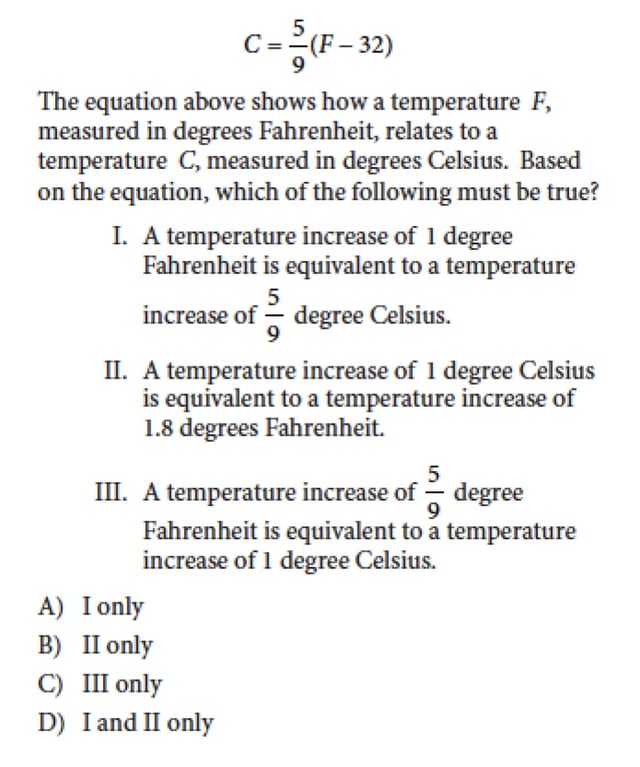
Posted on 23 February 2017 - 04:04 PM
Cleqn wrote
Let's look at each case.
i.) Let's distribute the (5/9): C = (5/9)F - k, k is the constant that we don't need or care about at the moment.
If we let F be 1, then C(1) = (5/9) - k. Now, if F is 2, we have C(2) = (5/9)(2) - k. Then the C(2) - C(1) = 5/9, so in one step of Fahrenheit, we've changed by 5/9 in Celsius, meaning that i.) is true.
ii.) Let's solve for F in terms of C: (9/5)C + 32 = F. Again, F(2) = (9/5)(2) + 32; F(1) = (9/5) + 32. Then F(2) - F(1) = 9/5 = 1 + (4/5) = 1.8. Hence, a change in one degree of Celsius gives a change of 1.8 in Fahrenheit. Thus, ii.) is true.
Immediately, we can say that the answer is D.) since that is the only solution that gives i.) and ii.) being true.
For the sake of completeness, consider iii.)
A change of 5/9 in Fahrenheit would cause a change of (5/9)(5/9) = 25/81 in Celsius, so iii.) is false.
Posted on 24 February 2017 - 10:21 AM
Who would win in a fight: Nessie vs tag team of Suppressed Sasquatch (50-60% power), Spongebob, Peter Griffin, Obama Post RoSaT and Huahwi?Posted on 24 February 2017 - 10:27 AM
NaomiBliss wrote
Who?
Posted on 24 February 2017 - 10:29 AM
NaomiBliss wrote
Forgot to mention, all blood-lusted and first fight is in the Loch Ness and the 2nd fight is in the plains by the Loch Ness