
Last edited on 19 January 2017 - 08:44 PM by AlbertEinstein
Zaptelus wrote
EhhThing wrote...
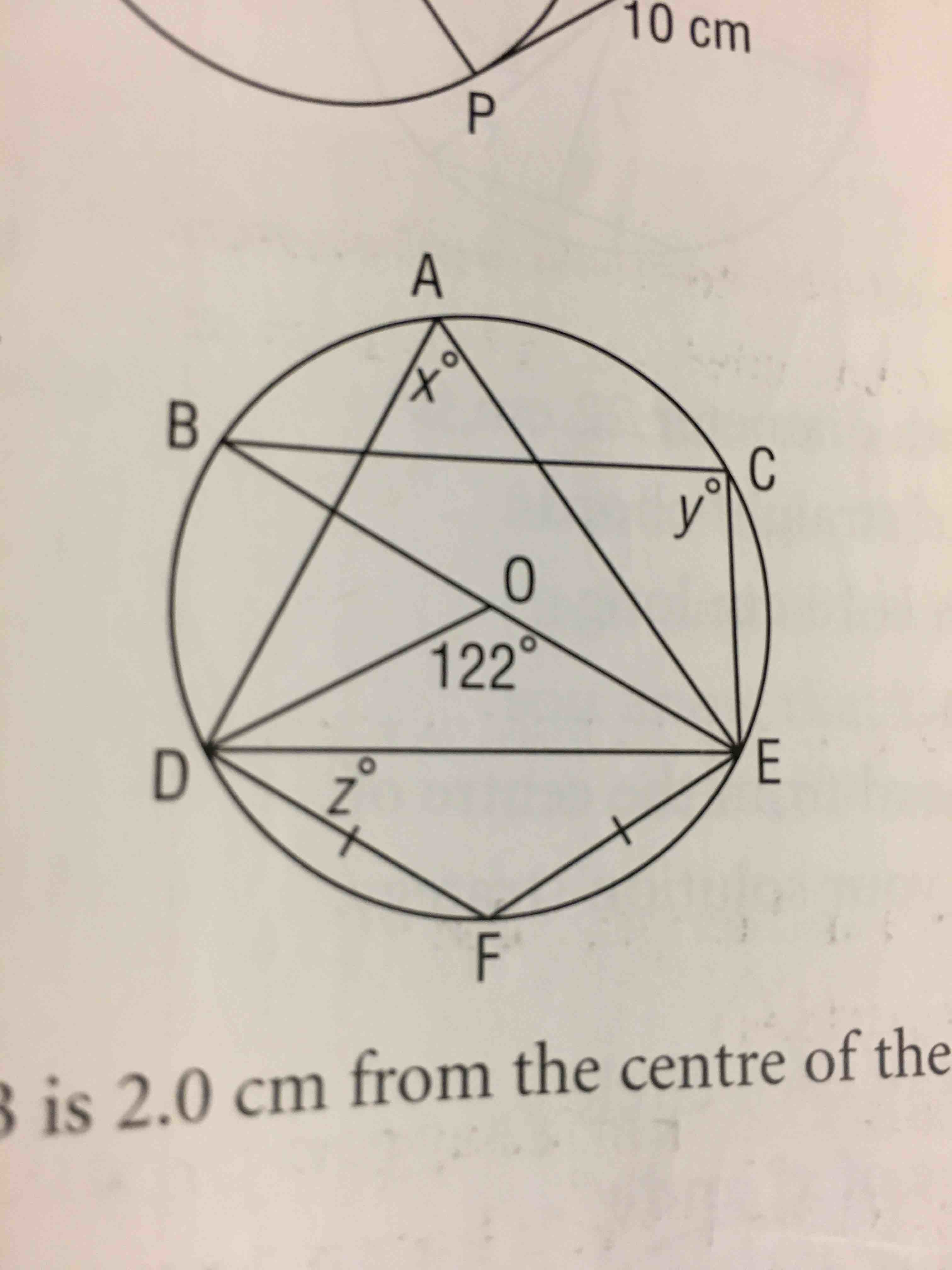
I'm looking for the angle.
As he said, OE = OD, since they're radii.
But there's another important radius that we need to consider!
OF is a radius as well, and of course, it's congruent to OE and OD. But with that, we just made two isosceles triangles. And we know that the opposite angles are congruent on isosceles triangles.
Hence, angle ODF is congruent to angle OFD. And we can quickly find what angle ODE is by noting that triangle ODE is isosceles as well (x + x + 122 = 180 —> x = 29). That means that angles ODF and OEF are (z + 29), and angle DEF is 2(z + 29).
The sum of angles in a quadrilateral is always 360 (two triangles = 180*2 = 360).
Thus, we must solve for z: 122 + (z+29) + (z+29) + 2(z+29) = 360 —> 4(z+29) = 238 —-> z+29 = 59.5 —> z = 30.5 degrees.
Edit: Yes, I know I was sloppy with my "congruent" and "equal" terminology, but I hope I conveyed my point effectively.
Last edited on 19 January 2017 - 08:48 PM by *deleted-96553
Automatically DeletedLast edited on 26 January 2017 - 11:52 PM by whitpillow
whats the factor of 64-a^3, 1-x^3, and 8-x^3and factor the expression 64x^3-125y^3 216x^3-125y^3 8-y^3
Posted on 26 January 2017 - 11:48 PM
whitpillow wrote
twenty
Last edited on 27 January 2017 - 12:48 AM by whitpillow
and factor the expressionsx^6y^6-1 and 216-x^3y^3
im in desperate need for help if anyone wants to chime in :D
Posted on 27 January 2017 - 01:23 AM
Do you do midterms?Posted on 27 January 2017 - 02:02 AM
whitpillow wrote
and factor the expression 64x^3-125y^3 216x^3-125y^3 8-y^3
These are differences of two cubes.
In general, a^3 - b^3 = (a-b)(a^2 + ab + b^2).
So, in your cases, 64 = 16*4 = 4^3, 8 = 2^3.
Thus, 64 - a^3 = 4^3 - a^3 = (4 - a)(4^2 + 4a + a^2) = (4-a)(16 + 4a + a^2).
1 - x^3 = 1^3 - x^3 = (1-x)(1^2 + 1*x + x^2) = (1-x)(1 + x + x^2).
8 - x^3 = 2^3 - x^3 = (2-x)(2^2 + 2x + x^2) = (2-x)(4 + 2x + x^2).
64x^3 - 125y^3 = (4x)^3 - (5y)^3 = (4x - 5y)(16x^2 + 20xy + 25y^2).
216x^3 -125y^3 = (6x)^3 - (5y)^3 = (6x - 5y)(36x^2 + 30xy + 25y^2).
8 - y^3 is exactly the same as the one with x, but in this case, it's just a y.
Posted on 27 January 2017 - 02:05 AM
whitpillow wrote
x^6y^6-1 and 216-x^3y^3
im in desperate need for help if anyone wants to chime in :D
Remember that a^6 = (a^2)^3 (multiply exponents like that).
Thus, (x^6)(y^6) - 1 = ((xy)^2)^3 - 1^3 = ((xy)^2 - 1)((xy)^4 + (xy)^2 + 1).
We can factor that further by using the difference of two squares on the first factor:
((xy)^2 - 1) = (xy + 1)(xy - 1) —> finally, (xy + 1)(xy - 1)(x^4 y^4 + x^2 y^2 + 1).
Use the same reasoning for the second one.
Posted on 27 January 2017 - 02:06 AM
Prisoners wrote
Yeah, post it here, and I'll do the whole thing.
(Please, don't–but I'll help with some questions if necessary lol)
Posted on 27 January 2017 - 06:16 AM
Explain why Neil thinks I don't understand what velocity isPosted on 29 January 2017 - 03:35 PM
Can every even integer greater than 2 be written as the sum of two primes?Posted on 29 January 2017 - 04:34 PM
well im only 11 but i was wondering if you can do my homeworkPosted on 29 January 2017 - 04:36 PM
https://gyazo.com/7992413d6b0c66459fd51d58a0f4e55aplease do my homework man please
Posted on 29 January 2017 - 05:04 PM
no english?i dont english pls help
Posted on 29 January 2017 - 06:33 PM
Automatically DeletedPosted on 29 January 2017 - 11:47 PM
bloodwave1 wrote
http://www.smileyme.com/school_supplies/charts/educational_incentive/1-100_numbers_learing_charts.gif
Posted on 29 January 2017 - 11:47 PM
Jinxful wrote
He thinks you're mixing up pot "trajectory" and pot "velocity."
Posted on 29 January 2017 - 11:48 PM
Mr_Bloxley wrote
i dont english pls help
No te puedo ayudar.
Posted on 29 January 2017 - 11:50 PM
Silverdonuts wrote
If that's your homework, then there's not a single person in the world who has passed that class.
>Goldbach's Conjecture
Posted on 30 January 2017 - 08:47 AM
Automatically Deleted