
Posted on 30 January 2017 - 09:50 AM
HitDelay wrote
Using integration by parts, find ∫x²cos(x)dx
Explain the steps to me as if I'm a 10 year old please. I'm sure your patronising self will enjoy it.
Thank you.
Interesting you call me patronizing on here, since for most of these answers, I've carefully avoided it.
Anyways, integration by parts is a great method for integrals, and it might help to understand how it's derived.
Recall the product rule (I'll be using primes to denote first derivatives with respect to x–assuming these are single-variable functions in x): (uv)' = u'v + uv'.
If we integrate both sides with respect to x now, we have int(uv)'dx = int(u'v)dx + int(uv')dx
–> uv = int(u'v)dx + int(uv')dx.
Thus, if we want to find what int(uv')dx is, and we know we can easily solve int(u'v)dx, then we have the simple formula:
int(uv')dx = uv - int(u'v)dx.
So in our case, we want to eliminate the x^2 by letting it be u (see above), since the formula calls for it to be differentiated.
When I do these, I always set up a 2x2 grid:
u (the one we want to get rid of) = x^2 | dv (derivative of the one we can easily integrate and is usually cyclic) = cos(x) dx
du (deriv. of one we want to get rid of) = 2x dx | v (usually cyclic one that can't get rid of) = sin (x)
And then I just start at the top left and go diagonal for the (uv) term, and then start at bottom left and head right for the int(u'v)dx term (remembering that du/dx = u').
So we have,
int(x^2 cosx)dx = (x^2)sinx - int(2x sinx)dx.
Now, we still can't do that second integral, so we have to do it again and eliminate the x.
Setting up the table, we have
u = 2x | dv = sinx dx
du = 2 dx | v = -cosx
Then, the integral is now
int(x^2 cosx)dx = (x^2)sinx - [-2x cosx - int(-2cosx)dx] = (x^2)sinx + 2x cosx - 2 int(cosx)dx.
We can finally integrate that last part now to sinx. Thus,
int(x^2 cosx)dx = (x^2)sinx + 2x cosx - 2 sinx = (x^2 -2)sinx + 2x cosx + c.
Checking by taking the derivative with respect to x, we have
(2x)sinx + (x^2 - 2)cosx + 2cosx - 2x sinx = (x^2) cosx, as desired.
Posted on 30 January 2017 - 06:17 PM
AlbertEinstein wrote
Silverdonuts wrote...
If that's your homework, then there's not a single person in the world who has passed that class.
>Goldbach's Conjecture
No it's not my homework I just wanted to see you try to solve it lmao.
Posted on 31 January 2017 - 07:53 PM
I've got a pretty bad teacher, nobody in my class understands what she's saying but I hope you answer this sometime tonight xDThis is elimination & substitution
1.
5s + 2z = 1.32
3s + 1z = .75
2.
8T + 10B = 80
9T + 5B = 65
3.
160a + 340s = 1480
80a + 400s = 1200
4.
3s + 4a = 2740 (not sure how my teacher expects us to solve this but hopefully Albert Einstein will)
Posted on 31 January 2017 - 07:58 PM
1+1Posted on 01 February 2017 - 05:02 AM
ProgressiveHouse wrote
This is elimination & substitution
1.
5s + 2z = 1.32
3s + 1z = .75
2.
8T + 10B = 80
9T + 5B = 65
3.
160a + 340s = 1480
80a + 400s = 1200
4.
3s + 4a = 2740 (not sure how my teacher expects us to solve this but hopefully Albert Einstein will)
For the first one, this is good for substitution, because we have a coefficient of 1 on the z. Substitution is usually better when you can quickly solve for one of the variables without having a mess of fractions arise.
So, 3s + z = .75 —> z = .75 - 3s. Now we substitute it in on the first equation:
5s + 2(.75 - 3s) = 1.32 —> 5s + 1.5 - 6s = 1.32 —> -s = -0.18, so s = 0.18.
Now, we can quickly go back to the second equation and find z by substituting in the value we just found:
3(0.18) + z = .54 + z = .75 —> z = 0.21.
For the second one, elimination looks easier. We want to get a pair of matching coefficients (opposite and equal) so that they cancel out when we add the two equations together.
Let's scale the second equation by (-2) to get -18T - 10B = -130. The tens match up, so let's add the two equations together:
8T + 10B = 80
-18T -10B = -130
—————–
-10T + 0B = -50, so -10T = -50, and T = 5.
We can now back substitute to get 8(5) + 10B = 80, so 40 + 10B = 80, so 10B = 40, so B =4.
For the third problem, you'll notice that the coefficients on a are off by a multiple of two. So let's multiply the second one by -2 so we can get an equal and opposite coefficient to eliminate the variable a and then add to the first:
-160a - 800s = -2400
160a + 340s = 1480
——————–
0a - 460s = -920, so s = 2.
Back substituting, we have 160a + 340(2) = 160a + 680 = 1480 —> 160a = 800 —> a = 5.
For the last one, this is really just the equation of a line, so there are infinite solutions to this equation.
You could find some integer solutions to it if you try hard enough, but I don't know what your teacher was asking for.
Posted on 01 February 2017 - 08:20 AM
AlbertEinstein wrote
ProgressiveHouse wrote...
For the first one, this is good for substitution, because we have a coefficient of 1 on the z. Substitution is usually better when you can quickly solve for one of the variables without having a mess of fractions arise.
So, 3s + z = .75 —> z = .75 - 3s. Now we substitute it in on the first equation:
5s + 2(.75 - 3s) = 1.32 —> 5s + 1.5 - 6s = 1.32 —> -s = -0.18, so s = 0.18.
Now, we can quickly go back to the second equation and find z by substituting in the value we just found:
3(0.18) + z = .54 + z = .75 —> z = 0.21.
For the second one, elimination looks easier. We want to get a pair of matching coefficients (opposite and equal) so that they cancel out when we add the two equations together.
Let's scale the second equation by (-2) to get -18T - 10B = -130. The tens match up, so let's add the two equations together:
8T + 10B = 80
-18T -10B = -130
—————–
-10T + 0B = -50, so -10T = -50, and T = 5.
We can now back substitute to get 8(5) + 10B = 80, so 40 + 10B = 80, so 10B = 40, so B =4.
For the third problem, you'll notice that the coefficients on a are off by a multiple of two. So let's multiply the second one by -2 so we can get an equal and opposite coefficient to eliminate the variable a and then add to the first:
-160a - 800s = -2400
160a + 340s = 1480
——————–
0a - 460s = -920, so s = 2.
Back substituting, we have 160a + 340(2) = 160a + 680 = 1480 —> 160a = 800 —> a = 5.
For the last one, this is really just the equation of a line, so there are infinite solutions to this equation.
You could find some integer solutions to it if you try hard enough, but I don't know what your teacher was asking for.
god you are smart
hopefully we don't have the same worksheet again tonight lol
Posted on 01 February 2017 - 08:58 PM
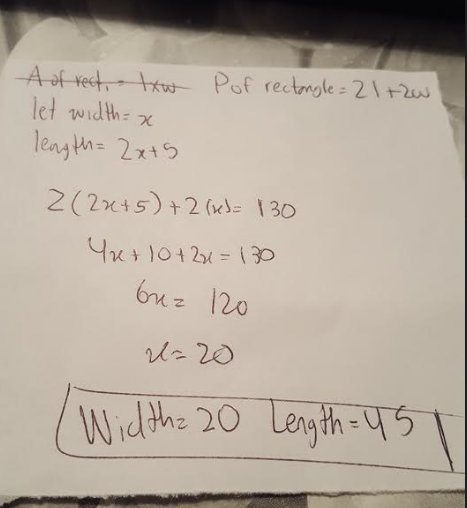
1. The length of a rectangle is 5 more than twice the width. The perimeter is 130 cm. Find the length and the width.2. Brndy and Dfield are selling magazines. Brndy has sold half as many as Dfield. Together they have sold 474 magazines. How many has each sold?
again with substitution and elimination
Posted on 01 February 2017 - 09:25 PM
Can you help me with these factoring by grouping problems? Even though my teacher marked those few right, I frankly have no idea what I'm doing.

Last edited on 01 February 2017 - 09:58 PM by ThatOneCombo
ProgressiveHouse wrote
2. Brndy and Dfield are selling magazines. Brndy has sold half as many as Dfield. Together they have sold 474 magazines. How many has each sold?
again with substitution and elimination
Posted on 01 February 2017 - 10:03 PM
ThatOneCombo wrote
ProgressiveHouse wrote...
next one is
Brndy = x
Dfield = 2x
x + 2x = 474
3x = 274
x = 158
Brndy = 158
Dfield = 316
Posted on 02 February 2017 - 12:51 AM
ProgressiveHouse wrote
2. Brndy and Dfield are selling magazines. Brndy has sold half as many as Dfield. Together they have sold 474 magazines. How many has each sold?
again with substitution and elimination
Combo boy's solutions are correct!
Posted on 02 February 2017 - 01:15 AM
Unshift wrote
Most of the ones in the first picture are applications of the difference of two squares factoring technique, thought they might not seem as intuitive.
a^2 - b^2 = (a+b)(a-b), as it seems you already know.
On 44, 4(x+y)^2 - (2y-z)^2 = [2(x+y)]^2 - (2y-z)^2 = (2(x+y)+2y-z)(2(x+y)-(2y-z)) = (2x + 2y + 2y - z)(2x + 2y - 2y + z)
= (2x + 4y - z)(2x + z).
It's pretty straightforward following the formula. The only part you need to be careful of is not mixing up your signs or coefficients when you distribute them inside the actual factors.
As for factoring by grouping, I'll go through a few of these and hope you can take if from there.
The idea is to factor two groups of terms and then hope you can factor some of the factors that you just factored.
For example, x^2 - 2xy + y^2 - 4. Let's try factoring the first two terms and the last two terms (common term and diff. of two squares, respectively):
x^2 - 2xy + y^2 -4 = x(x-2y) + (y+2)(y-2). Nothing comes out of this one. There are no common factors, so let's rearrange it a bit:
Try (y^2 - 2xy) + (x^2 -4) = y(y-2x) + (x+2)(x-2). Again, nothing. So we're probably doing something wrong.
Looking back at the original statement, we have a perfect square trinomial at the beginning: x^2 - 2xy + y^2 = (x-y)^2.
So, we have x^2 -2xy + y^2 = (x-y)^2 - 4 = (x-y+2)(x-y-2), by difference of two squares.
For 45, I again see a perfect square trinomial hidden in there: -v^2 + 2v - 1 = -(v^2 - 2v + 1) = -(v-1)^2.
Thus, u^2 - v^2 +2v -1 = u^2 - (v-1)^2 = (u+v-1)(u-v+1).
Next is 46. Immediately, there's a perfect square trinomial in m: m^2 - n^2 - 2m + 1 = (m^2 - 2m + 1) - n^2
= (m-1)^2 - n^2 = (m - 1 + n)(m - 1 - n).
In the end, this wasn't even really factoring by grouping, but instead, just indirect uses of difference of two squares.
Posted on 02 February 2017 - 08:16 AM
ThatOneCombo wrote
ThatOneCombo wrote...
next one is
Brndy = x
Dfield = 2x
x + 2x = 474
3x = 274
x = 158
Brndy = 158
Dfield = 316
combo you fucking legend
Posted on 02 February 2017 - 09:15 AM
ProgressiveHouse wrote
ThatOneCombo wrote...
combo you fucking legend
Gimme more of these!!! Log functions are pissing me off
Posted on 02 February 2017 - 10:07 AM
ThatOneCombo wrote
ProgressiveHouse wrote...
Gimme more of these!!! Log functions are pissing me off
Solve 16^(x-3) - 13*8^(x-3) + 61*4^(x-3) - 123*2^(x-3) + 90 = 0 for x.
Posted on 02 February 2017 - 12:44 PM
AlbertEinstein wrote
ThatOneCombo wrote...
Solve 16^(x-3) - 13*8^(x-3) + 61*4^(x-3) - 123*2^(x-3) + 90 = 0 for x.
I feel like there is an easy way to do this but I'm in school rn, will do when I get home
Last edited on 02 February 2017 - 06:32 PM by lmBlitz
ProgressiveHouse wrote
This is elimination & substitution
1.
5s + 2z = 1.32
3s + 1z = .75
2.
8T + 10B = 80
9T + 5B = 65
3.
160a + 340s = 1480
80a + 400s = 1200
4.
3s + 4a = 2740 (not sure how my teacher expects us to solve this but hopefully Albert Einstein will)
For the last one, I believe the way to do it is by finding what s equals with a in the solution
3s + 4a = 2740
-3s -3s
4a = -3s + 2740
divide by 4 on all of them
a = -3/4s + 685
then for s -
3s + 4a = 2740
-4a -4a
3s = -4a + 2740
divide by 3 on all of them
s = -4/3a + 913.3
I may be wrong, but it's worth the shot.
Posted on 02 February 2017 - 11:34 PM
Silverdonuts wrote
ProgressiveHouse wrote...
For the last one, I believe the way to do it is by finding what s equals with a in the solution
3s + 4a = 2740
-3s -3s
4a = -3s + 2740
divide by 4 on all of them
a = -3/4s + 685
then for s -
3s + 4a = 2740
-4a -4a
3s = -4a + 2740
divide by 3 on all of them
s = -4/3a + 913.3
I may be wrong, but it's worth the shot.
This could be what the teacher was looking for.
I do remember questions where it asks you to change the form of a line from standard form to slope-intercept form (which is what you just did for both variables).
Posted on 03 February 2017 - 06:42 AM
ThatOneCombo wrote
AlbertEinstein wrote...
I feel like there is an easy way to do this but I'm in school rn, will do when I get home
2^(x-3) = t
t^4 - 13t^3 + 61t^2 - 123t + 90 = 0
(t-5) (t-3)^2 (t-2) = 0
1. t = 5
2^(x-3) = 5
log2(5) = x-3
x= log2(5) +3
2. t = 3
2^(x-3) = 3
x = log2(3) + 3
3. t=2
x=4
Posted on 03 February 2017 - 07:10 AM
Hobskey wrote
ThatOneCombo wrote...
2^(x-3) = t
t^4 - 13t^3 + 61t^2 - 123t + 90 = 0
(t-5) (t-3)^2 (t-2) = 0
1. t = 5
2^(x-3) = 5
log2(5) = x-3
x= log2(5) +3
2. t = 3
2^(x-3) = 3
x = log2(3) + 3
3. t=2
x=4

Correct!!!