
Posted on 03 February 2017 - 07:21 AM
AlbertEinstein wrote
Hobskey wrote...
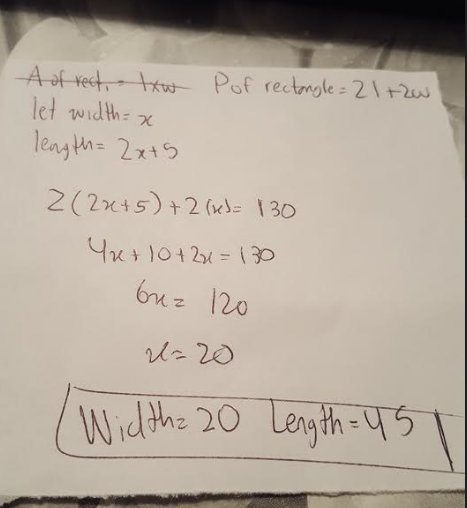

Correct!!!
Gimme another one I'll try
Posted on 03 February 2017 - 02:22 PM
AlbertEinstein wrote
Unshift wrote...


Most of the ones in the first picture are applications of the difference of two squares factoring technique, thought they might not seem as intuitive.
a^2 - b^2 = (a+b)(a-b), as it seems you already know.
On 44, 4(x+y)^2 - (2y-z)^2 = [2(x+y)]^2 - (2y-z)^2 = (2(x+y)+2y-z)(2(x+y)-(2y-z)) = (2x + 2y + 2y - z)(2x + 2y - 2y + z)
= (2x + 4y - z)(2x + z).
It's pretty straightforward following the formula. The only part you need to be careful of is not mixing up your signs or coefficients when you distribute them inside the actual factors.
As for factoring by grouping, I'll go through a few of these and hope you can take if from there.
The idea is to factor two groups of terms and then hope you can factor some of the factors that you just factored.
For example, x^2 - 2xy + y^2 - 4. Let's try factoring the first two terms and the last two terms (common term and diff. of two squares, respectively):
x^2 - 2xy + y^2 -4 = x(x-2y) + (y+2)(y-2). Nothing comes out of this one. There are no common factors, so let's rearrange it a bit:
Try (y^2 - 2xy) + (x^2 -4) = y(y-2x) + (x+2)(x-2). Again, nothing. So we're probably doing something wrong.
Looking back at the original statement, we have a perfect square trinomial at the beginning: x^2 - 2xy + y^2 = (x-y)^2.
So, we have x^2 -2xy + y^2 = (x-y)^2 - 4 = (x-y+2)(x-y-2), by difference of two squares.
For 45, I again see a perfect square trinomial hidden in there: -v^2 + 2v - 1 = -(v^2 - 2v + 1) = -(v-1)^2.
Thus, u^2 - v^2 +2v -1 = u^2 - (v-1)^2 = (u+v-1)(u-v+1).
Next is 46. Immediately, there's a perfect square trinomial in m: m^2 - n^2 - 2m + 1 = (m^2 - 2m + 1) - n^2
= (m-1)^2 - n^2 = (m - 1 + n)(m - 1 - n).
In the end, this wasn't even really factoring by grouping, but instead, just indirect uses of difference of two squares.
Posted on 03 February 2017 - 09:06 PM
Oh, a random question, why do you think cross-products/cross-cancelling/cross multiplying works? What is so relative between numbers that lie diagonally across from each other?Posted on 04 February 2017 - 06:20 AM
Hobskey wrote
AlbertEinstein wrote...
Gimme another one I'll try
Coming up with reasonably challenging problems is challenging.
Eventually.
Posted on 04 February 2017 - 06:29 AM
Unshift wrote
Not sure what you're asking, so I'll just say a bunch of stuff and hope it covers it.
That thing you learn in school–"FOIL"–is not just an arbitrary algorithm to expand products. It's a direct application of an axiom of the real numbers: distributivity (distributive property).
So if you expand (a+b)(c+d), it's really just (a+b)c + (a+b)d = ac + bc + ad + bd.
Now, what I think you're asking is why when you multiply polynomials vertically, why they end up canceling out in order:
x^2 + 2x + 4
x^2 - 3x - 6
============
-6x^2 - 12x - 24
-6x^2 - 12x -3x^3
+4x^2 +2x^3 + x^4
==============================
x^4 - x^3 - 8x^2 - 24x - 24
The reason it works out like this is the same reason that you can multiply 435 by 29. Instead of x's, you have powers of ten (because we work in the base ten, decimal system).
Writing 43 as 4*10^2 + 3*10^1 + 5*10^0 and 29 as 2*10^1 + 9*10^0, we use the same algorithm above to get the answer. I won't go through it, but I think you get the point.
All of these operations stem back to the axioms of the real numbers that you probably learned at the beginning of the class and that you most likely disregarded (as almost everyone does at first) as being obvious and unimportant.
Posted on 04 February 2017 - 07:27 AM
Automatically DeletedPosted on 05 February 2017 - 07:37 AM
Pikqchu wrote
It would really help me remember. Thanks.
Give me an example of this technique, and also give me an example if what you mean by "list of integrated forms," because usually there is a nice list in the front or back of your calculus textbook.
Posted on 05 February 2017 - 12:13 PM
AlbertEinstein wrote
Unshift wrote...
Not sure what you're asking, so I'll just say a bunch of stuff and hope it covers it.
That thing you learn in school–"FOIL"–is not just an arbitrary algorithm to expand products. It's a direct application of an axiom of the real numbers: distributivity (distributive property).
So if you expand (a+b)(c+d), it's really just (a+b)c + (a+b)d = ac + bc + ad + bd.
Now, what I think you're asking is why when you multiply polynomials vertically, why they end up canceling out in order:
x^2 + 2x + 4
x^2 - 3x - 6
============
-6x^2 - 12x - 24
-6x^2 - 12x -3x^3
+4x^2 +2x^3 + x^4
==============================
x^4 - x^3 - 8x^2 - 24x - 24
The reason it works out like this is the same reason that you can multiply 435 by 29. Instead of x's, you have powers of ten (because we work in the base ten, decimal system).
Writing 43 as 4*10^2 + 3*10^1 + 5*10^0 and 29 as 2*10^1 + 9*10^0, we use the same algorithm above to get the answer. I won't go through it, but I think you get the point.
All of these operations stem back to the axioms of the real numbers that you probably learned at the beginning of the class and that you most likely disregarded (as almost everyone does at first) as being obvious and unimportant.
Been wondering exactly why it works ever since then, and the same goes for solving proportions by cross-multiplying. Why are numbers that lie diagonally from each other relative?
Posted on 05 February 2017 - 12:25 PM
Unshift wrote
AlbertEinstein wrote...
Been wondering exactly why it works ever since then, and the same goes for solving proportions by cross-multiplying. Why are numbers that lie diagonally from each other relative?
That's just a clever way of teaching younger kids how to solve that type of equations for proportions.
It's all thanks to, as I said in my previous response, the distributive property of multiplication.
For example, for cross-cancelling, (12/14)(7/3) (12*7)/(14*3) (associativity) = (7*12)/(14*3) (commutativity) = (7/14)(12/3) (associativity) = (1/2)(4/1) (evaluation) = 2.
It also works on the denominator: (12/7)(9/4) = (12*9)/(7*4) = (12*9)/(4*7) = (12/4)(9/7) = (3/1)(9/7) = (27/7).
For proportions, (x/13) = (2/7), and by cross multiplication, we'd get 7x = 2*13.
Taking a more axiomatic method, we will get the same result,
(x/13) = (2/7) —> (7*13) (x/13) = (7*13) (2/7) (multiply both sides by 7*13) —> 7x = 2*13 ("cross cancelling").
Again, these are just intuitive tricks/algorithms that teachers have found effective on teaching younger kids. I mean, try telling a second grader to "employ associativity and commutativity to reduce your quotients to relatively prime integers."
Instead, you just say, "OK, kiddo, these diagonal ones are arch enemies and kill each other off."
Posted on 05 February 2017 - 01:09 PM
Kind of a philosophical question, but do you think we will ever go in a nuclear war? What would be the effects of said war?Posted on 09 February 2017 - 03:47 PM
The curve y = x^3/6 + 1/2x, 1/2 ≤ x ≤ 1 is rotated about the x-axis. Find the area of the surface of revolution.Posted on 09 February 2017 - 09:27 PM
jpalm wrote
This will be my first hand-written one, because I'm not going to type up messy, ambiguous notation on BL forums.
This is most likely wrong, so please, use Wolfram Alpha (I had to use it a bit to make sure it was integrable easily enough). Use this as a guideline for maybe a more careful calculation.

Posted on 09 February 2017 - 09:30 PM
Silverdonuts wrote
If we do, I'm afraid it'll be "mutually assured destruction," meaning our foes die along with all of us.
That's the end game right there if we go to nuclear war.
Will we ever do it? I don't know.
Posted on 10 February 2017 - 03:20 PM
irl are you a math teacher or something? xdPosted on 10 February 2017 - 03:21 PM
Boi your smartPosted on 10 February 2017 - 05:40 PM
CraftainJulius wrote
Student.
Posted on 10 February 2017 - 05:40 PM
BlueMinionHD wrote
tyvm
Posted on 11 February 2017 - 06:15 AM
how old are you?are you planning on getting a PHD or something in the future?
and if you and @Hivlik make a baby, it would probs be the smartest minecrafter ever :o
Posted on 11 February 2017 - 08:38 AM
Reddy23 wrote
are you planning on getting a PHD or something in the future?
and if you and @Hivlik make a baby, it would probs be the smartest minecrafter ever :o
Not old enough to legally drink in the USA.
Yes, that's the plan at the moment. You can't realy do much in science unless you have a PhD, unless you want to be a high school teacher or something.
Haha, he commented on this forum a while back. I haven't really talked to him though.
Posted on 11 February 2017 - 12:12 PM
Imagine you're on a game show, and you're given the choice of three doors: Behind one door is a million dollars, and behind the other two, nothing. You pick door #1, and the host, who knows what's behind the doors, opens another door, say #3, and it has nothing behind it. He then says to you, "Do you want to stick with your choice or switch?"So, is it to your best advantage to stick with your original choice or switch your choice?
AND WHY?!